 Francisco Yepes Barrera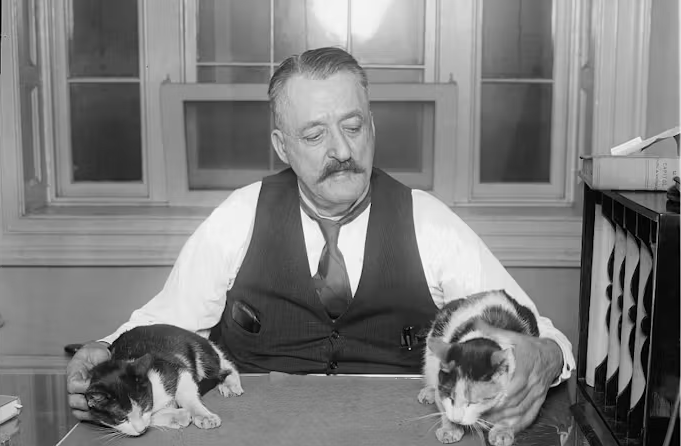
City Cats, 1927. Source: Library of Congress, CC BY.
This article was published in Spanish in the Cuaderno de Cultura Cientifica (CCC) under the title “¿Quién mató al gato de Schrödinger?“, under a Creative Commons Attribution-NonCommercial-NoDerivatives 4.0 International License. The article was originally published in The Conversation (original article). Except for the English translation, no changes were made to the original article. Published with permission of CCC.
The author,Juan Antonio Aguilar Saavedra, is a research scientist in theoretical elementary particle physics at the Spanish National Research Council (CSIC, Consejo Superior de Investigaciones Científicas).
Neither alive nor dead, but quite the opposite. Schrödinger’s cat is the iconic paradox of quantum mechanics, proposed in 1935 as a thought experiment by physicist Erwin Schrödinger. According to quantum principles, a cat enclosed in a box could be simultaneously alive and dead—in a superposition of states—until the box is opened and it is observed.
Superposition is not observed in everyday macroscopic systems. But it has been verified in elementary particles and molecules, and it serves to introduce one of the main unresolved aspects of quantum mechanics.
Table of Contents
The Problem of Measurement
The orthodox interpretation of quantum mechanics, called the Copenhagen interpretation, introduces a separation between system and observer. When an observer measures a property of the system, they cause that property to acquire a defined value, which in quantum mechanics is called “state collapse.”
This topic has been extensively covered in both specialized literature and popular science. But here we will focus on a different aspect, and to illustrate it, nothing is better than revisiting a classic example.
Schrödinger’s Cat 2.0
Let’s now consider a more sophisticated version of the hypothetical Schrödinger’s cat experiment using qubits. Qubits are the basic units of information in quantum computers. They can be in a state |0>, |1>, or a superposition of both.
Two scientists, Alice and Bob, each have a qubit, A and B respectively. They set up a box with another qubit, C, and a device such that if C is in state |0>, it releases a deadly poison, while if it is in state |1>, it opens the box and lets the cat escape.
Alice and Bob prepare the three-qubit system in an entangled state |ABC> = |000> + |111> and lock the poor cat in the box. Then they each leave with their respective qubits for their laboratories, located at opposite ends of the city.
As long as Alice and Bob don’t observe the state of their qubits, nothing bad can happen: qubit C, on which the cat’s life depends, is not in a defined state. But as soon as one of them observes their qubit, they will force it to be defined: either |0> or |1>. And with that, they will cause the entire entangled state of the three qubits to collapse, either into |000> or |111>. In the first case, the cat will die, while in the second, it will be able to escape the box.
Inevitably, Alice ends up observing the state of her qubit A, and unfortunately, she obtains the result |0>, and her measurement causes the entangled state to collapse into |000>. Thus, the cat dies. A moment later, Bob also observes his qubit B, which, after Alice’s measurement, has already collapsed into a defined state |0>.
Alice and Bob, Who Looked First?
Naturally, the death of his cat infuriates Schrödinger, who sues Alice and Bob for the experiment. At the trial, the prosecution claims that Alice was the first to observe her qubit, causing the state to collapse to |000>, and thus leading to the fatal outcome. However, Alice’s lawyer has an ace up her sleeve and has requested an expert report from Albert Einstein.
Einstein admits that, for any witness in the city’s frame of reference, Alice observed her qubit before Bob did. But he also points out the great distance between Alice’s and Bob’s laboratories and the minuscule instant of time that elapsed between Alice observing her qubit A and Bob observing B.
Einstein notes that the time difference between the two observations is less than the time it would take light to travel between the two laboratories, calling the interval between the two observations “space-like” in his terminology. He states that, according to his theory of relativity, in these cases the temporal order is relative: it depends on the frame of reference.
Einstein affirms under oath that, for another witness traveling at sufficient speed, it was Bob who first observed his qubit B and obtained |0>, thus collapsing the system. Therefore, it was Bob who caused the tragic outcome. Faced with these arguments, the judge cannot determine the guilt of either Alice or Bob and is forced to declare both not guilty of the cat’s death. However, he does reprimand them for experimenting.
Experiments with Muons
The Copenhagen interpretation of measurement (state collapse) clashes with special relativity. According to this interpretation, for an entangled A-B system in which measurements are performed on both subsystems, it is the first measurement that collapses the common state. But which one is first? Did Alice look first, or was it Bob who activated the poison?
In certain situations (space-like intervals between measurements), the temporal order is relative to who is describing it.
And the paradoxes related to quantum entanglement and time are not limited to “determining guilt,” as in the case of Alice and Bob. Another experiment, hypothetical but feasible (without the need for cats), has recently been described, presenting an even more intriguing paradox.
Let’s consider a pair of muonsA and B (unstable spin-1/2 particles) in an entangled state. The analogous state for qubits would be |AB> = |01> – |10>. We performed spin measurements on muon A almost simultaneously with the decay of muon B.
Here, the temporal order is also relative, as in the case of Alice and Bob. But there’s more: the very nature of the correlation between the measurement performed on muon A and the decay of muon B varies radically depending on who is describing it. Which is, to say the least, unsettling.
Is Quantum Mechanics the Definitive Theory?
These paradoxes suggest that the Copenhagen interpretation of the measure is merely a calculation tool. Although a minority view, this line of thinking is not new. In the words of N. Mermin:
“If I were forced to summarize what the Copenhagen interpretation says in a single sentence, it would be: ‘Shut up and calculate!’”
Is there an underlying theory to quantum mechanics that explains these paradoxes? Perhaps, when we manage to unify quantum mechanics with general relativity, we will know the answer.
Note: No cats were harmed in the making of this article.