
A Queen Sacrifice in the Heart of the Sicilian by a 12-Year-Old Boy • Shilov vs Kramnik • USSR Boys’ Championship • Baku, Azerbaijan (1987) • Sicilian Defense: Lasker-Pelikan, Sveshnikov Variation (B33)
 Francisco Yepes Barrera
2 min read
Francisco Yepes Barrera
2 min read
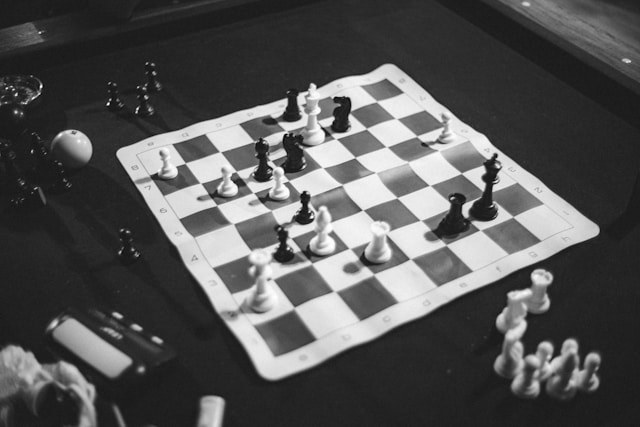
Frankie Cordoba - https://unsplash.com/photos/a-black-and-white-photo-of-a-chess-board-B1o2H_Ar0MY
In 1987, Kramnik was a 12-year-old prodigy. He had already been invited to the Mikhail Botvinnik school, where the former World Champion personally oversaw his development. This game shows the raw tactical talent that preceded his famous “invincible” positional style.
His opponent was Shilov, a strong Soviet youth player. In the massive ecosystem of Soviet chess, talented youngsters like Shilov provided the ultimate testing ground for future world champions.
The USSR Boys’ Championship (Baku, 1987) was one of the most rigorous youth competitions in the world. The Soviet Union treated chess as a state priority, and these championships were the primary filter for discovering the next generation of grandmasters. Playing in Baku, the hometown of Garry Kasparov, added an extra layer of prestige to the event.
Coming into this round, the young Kramnik was already a marked man due to his association with Botvinnik. The “eve” of such games in the Soviet school involved rigorous home preparation. Shilov likely aimed to challenge Kramnik’s theoretical knowledge by entering the sharpest lines of the Sicilian Sveshnikov, a brave choice against a player who would eventually become a master of all structures.
This game is a fascinating battle in the Sicilian Defence, Pelikan (Sveshnikov) Variation. It features a heavy theoretical sacrifice and a wild mid-game where the evaluation swings dramatically.
The game follows the sharp B33 line: 1. e4 c5 2. Nf3 Nc6 3. d4 cxd4 4. Nxd4 Nf6 5. Nc3 e5 6. Ndb5 d6. White enters the main line with 7. Bg5 a6 8. Na3 b5, leading to the classic Sveshnikov structure.
White plays the aggressive 12. Bxb5, a thematic piece sacrifice to exploit the holes in Black’s position. Kramnik’s response 12… Bd7 is noted as an error by the engine, suggesting that 12… axb5 was necessary to fight for the advantage.
The game becomes highly unusual after a massive exchange of material. By move 19, after 18. Bxd7 Nd3+ 19. Kf1 Rxd7, the board is chaotic. White has a Queen against Kramnik’s two Rooks and a Knight.
Initially, Shilov holds a significant advantage (+3.68 according to Stockfish), but the coordination of Kramnik’s pieces, particularly the Knight on d3 and the centralized King, makes the Queen difficult to utilize.
Shilov begins to lose the thread with 20. Qe2 and 26. f3. Kramnik’s pressure on the g-file with 26… Rg6 and the activation of his Bishop to d4 completely changes the dynamic.
The decisive blunder occurs with 31. Qe7?, allowing Kramnik to consolidate. White’s desperate 35. Rxe3 leads to a lost endgame where Kramnik’s advanced f-pawn is the hero. After 37… f2, Shilov resigned. The pawn will promote, or White will be forced to sacrifice the Queen to stop it, leading to a trivial win for Black.
Kramnik demonstrated that even at 12, he understood how to use non-standard material imbalances to confuse his opponents. While the Queen is theoretically stronger, the harmony between Kramnik’s Rooks and Bishop eventually overwhelmed the White King. This game is a building block in the career of the man who would eventually end Kasparov’s 15-year reign as world champion.