 Francisco Yepes Barrera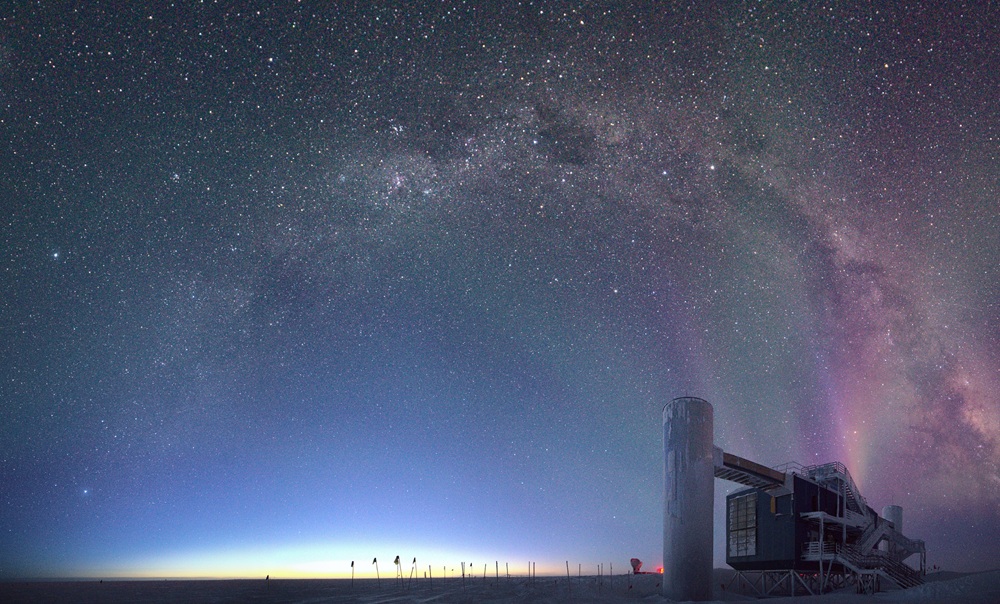
An experiment buried beneath the Antarctic ice has just rewritten what we thought we knew about the most elusive particles in the cosmos. Photo: John Hardin CC BY 4.0 / Wikimedia Commons (https://commons.wikimedia.org/w/index.php?curid=113385192).
This article was published in Spanish in the Cuaderno de Cultura Cientifica (CCC) under the title “Los neutrinos nos cuentan una historia nueva sobre el universo“, under a Creative Commons Attribution-NonCommercial-NoDerivatives 4.0 International License. Except for the English translation, no changes were made to the original article. Published with permission of CCC.
The author, César Tomé López is a scientific communicator and editor of Mapping Ignorance.
For decades, astronomers have observed the cosmos with light: first visible light, then radio waves, X-rays, and gamma rays. More recently, gravitational waves added a whole new dimension. And for just over a decade, we’ve had another extraordinary messenger: high-energy neutrinos from the depths of the universe. Now, a new result from the IceCube observatory has added a crucial chapter to this story. After analyzing more than ten years of data, researchers have published in the journal Physical Review Letters the strongest evidence to date that the flux of these cosmic neutrinos does not follow the simple pattern we had taken for granted for years. The spectrum shows a break. And that break matters more than it might seem.
Table of Contents
The Hardest Messengers to Catch
Neutrinos are subatomic particles with almost no mass and no electric charge. Every second, trillions of them pass through our bodies without leaving the slightest trace. This indifference to ordinary matter makes them extraordinarily valuable for astronomy: while light can be absorbed, deflected, or blocked by the gas, dust, or magnetic fields that fill space, neutrinos travel in a straight line from their point of origin to our detectors. They are almost perfect messengers of the violent universe.
The challenge is capturing them. To do this, scientists built IceCube, a one-of-a-kind detector located at the South Pole. Instead of a conventional telescope, the experiment uses an entire cubic kilometer of Antarctic ice as its detection medium: more than 5,000 optical sensors are deployed on 86 vertical cables, buried between 1,450 and 2,450 meters below the surface. When a neutrino collides with an atom in ice (something that happens extremely rarely), it produces a cascade of particles that emit a flash of bluish light, called Cherenkov radiation, which sensors record and scientists analyze.
In 2013, IceCube announced the first unequivocal discovery of neutrinos from deep space, outside our galaxy. It was the official birth of high-energy neutrino astronomy.
The Energy Spectrum and the Power Law
Since then, the fundamental question has been: how are the energies of these cosmic neutrinos distributed? The answer matters because the energy of neutrinos is directly related to the physical processes that generated them. Knowing this distribution allows us to infer which types of astrophysical objects dominate their production.
To put these energies into perspective: a teraelectronvolt (TeV) is equivalent to one trillion electronvolts, which is the basic unit of energy in particle physics. CERN’s Large Hadron Collider, the largest particle accelerator ever built, operates with energies of up to 13 TeV per collision. The neutrinos detected by IceCube arrive with energies ranging from a few TeV to 10,000 TeV, which is to say that the universe has natural accelerators incomparably more powerful than any human-made machine.
For years, the IceCube data seemed compatible with a relatively simple description: the so-called power law, in which the number of neutrinos decreases regularly and predictably as their energy increases. On a graph, this law draws a straight line. It’s the same kind of mathematical relationship that describes many natural phenomena, from earthquakes to the distribution of stellar brightness. It was a neat and convenient description. But the data never quite fit it: there were persistent (though not conclusive) hints that something strange was happening around tens of teraelectronvolts.
Ten Years of IceCube Data to Solve the Mystery
The new study represents the most comprehensive analysis to date of the diffuse flux of astrophysical neutrinos. Researchers combined two independent datasets, collected over more than a decade: one focused on trail events (produced by muon neutrinos that leave a long, well-defined trail of light, allowing for precise determination of their direction of origin) and the other based on cascade events (produced by electron and tau neutrinos, which transfer their energy in a compact region, enabling more precise energy measurement). The combination of both types of events is key to the robustness of the result, as each compensates for the weaknesses of the other.
The verdict is clear. The astrophysical neutrino spectrum cannot be described by a single power law across the entire energy range studied, which spans from 5 TeV to 10 PeV. The statistical evidence exceeds four sigma (in particle physics terms, the conventional threshold required by the scientific community to speak of a firm discovery; but speaking and asserting are two different things, and for that, five sigma are needed). The model that best describes the data is that of a broken power law: below a few tens of TeV, the spectrum is considerably richer in energetic neutrinos than would be expected if the observed trend were extrapolated to higher energies. From that point on, the drop becomes more pronounced.
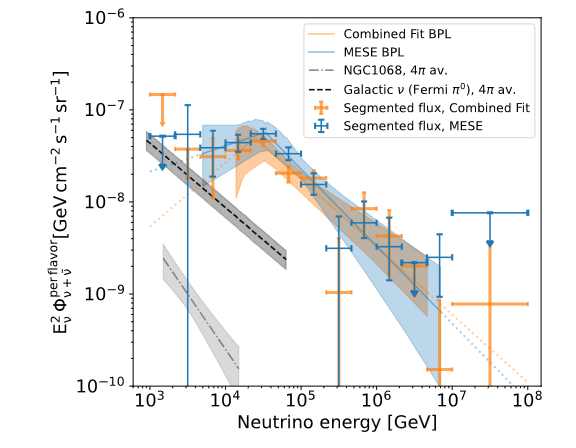
If we plot the spectrum on a graph, we wouldn’t get a straight line, but rather two sections with different slopes, joined around 30 TeV. The slope at low energies is much less steep (that is, there are relatively more energetic neutrinos than expected) than the slope at high energies.
What Could Be Causing this Breakup?
A break in the cosmic neutrino spectrum can have several explanations, and astrophysicists are already debating which is the most plausible.
The first possibility is that the diffuse flux—which doesn’t originate from a single identifiable source, but rather from the combined contribution of countless accelerators scattered throughout the observable universe—is actually the superposition of several populations from different sources. The most studied candidates include active galactic nuclei (AGN), compact regions at the center of certain galaxies where a supermassive black hole accretes material around it with a luminosity that can exceed that of our Sun by a trillion times; galaxies with intense star formation, in which cosmic rays interact densely with interstellar gas; and the remnants of stellar explosions. If different populations dominate in different energy ranges, the combined result could produce exactly the shape observed by IceCube.
The second possibility is that the breakup reflects the internal physics of the accelerators themselves: perhaps the neutrino production mechanisms—which involve the collision of accelerated charged particles with matter or photons—function differently depending on the energy. Some theories even predict that interactions with dark matter could leave a similar signature in the spectrum.
What the study does allow us to rule out is that the observed structure is an artifact of known and relatively nearby sources. The contribution of the emission from the Milky Way’s galactic plane and that of the brightest individual object detected by IceCube so far—the active galaxy NGC 1068, located about 47 million light-years away—is too small to explain the overall shape of the spectrum. This reinforces the idea that we are observing a collective and intrinsic property of the extragalactic population of neutrino sources.
A Puzzle That’s Starting to Fit Together
The discovery also has an unexpected connection to another major enigma in high-energy astrophysics: the relationship between cosmic neutrinos and the diffuse extragalactic gamma-ray background. Neutrinos and high-energy gamma rays are often produced together in the same hadronic processes, so any model that explains neutrinos must be compatible with what gamma-ray telescopes observe. For years, some researchers pointed out that extrapolating IceCube’s simple power law to lower energies created a tension with the gamma-ray background measured by the Fermi Space Telescope. The new spectrum, being harsher at low energies—that is, having relatively fewer neutrinos below 30 TeV than simple extrapolation would suggest—could partially alleviate this discrepancy. Sometimes an important discovery is not about finding something entirely new, but about making seemingly incompatible pieces begin to fit together.
The Beginning of a New Stage
The researchers acknowledge that there is some additional evidence of more subtle structures at even higher energies, but for now, it does not reach sufficient statistical significance. More data will be needed to determine whether it is a real signal or a statistical fluctuation.
In any case, the result presented marks a turning point. During the early years of neutrino astronomy, the main objective was simply to demonstrate the existence of extragalactic neutrinos and to measure their total flux. Then came the identification of the first individual sources. Now, attention is shifting toward something more ambitious: using the neutrino spectrum as a precision tool to dissect the populations of cosmic accelerators and the physical mechanisms operating in the most extreme environments of the universe.
When IceCube detected the first astrophysical neutrinos in 2013, many scientists compared the moment to the dawn of optical astronomy: humanity was gaining a new sense for exploring the cosmos. Thirteen years later, that sense is becoming even more refined. The universe doesn’t send us neutrinos following a simple, uniform pattern. There’s structure. There are nuances. There’s information hidden in the exact shape of the spectrum. And that’s precisely where the interest of the discovery lies: every deviation from a simple curve is a clue, every irregularity could point to an unknown population of cosmic accelerators or a physical mechanism we don’t yet fully understand. Neutrinos remain the most elusive particles in the universe. But, little by little, they are learning to tell their story. And that story has just become considerably more interesting.
Bibliography
R. Abbasi et al. (IceCube Collaboration) (2026) Evidence for a Spectral Break or Curvature in the Spectrum of Astrophysical Neutrinos from 5 TeV to 10 PeV Physical Review Letters doi: 10.1103/2gh9-d4q7.