 Francisco Yepes Barrera
Luka Savcic - https://unsplash.com/photos/silver-and-white-round-analog-watch-beside-white-printer-paper-evixqxe715k
Table of Contents
Introduction
A claimed proof of the Riemann Hypothesis (RH) immediately reshapes the landscape of analytic number theory, not merely because of the age of the problem, which dates back to Bernhard Riemann’s 1859 memoir on the number of primes less than a given magnitude, but because the conjecture acts as a structural hub connecting a vast web of conditional theorems across mathematics. At its core, the Riemann Hypothesis concerns the locations of the non-trivial zeros of the Riemann zeta function, defined for complex numbers s = \sigma + it with \sigma > 1 by the Dirichlet series
\zeta(s) = \sum_{n=1}^{\infty} \frac{1}{n^s} = \prod_{p} \left(1 - p^{-s}\right)^{-1}where the product runs over all prime numbers p. Through analytic continuation to \mathbb{C} \setminus {1} and its functional equation relating \zeta(s) to \zeta(1-s), the function exhibits trivial zeros at the negative even integers s = -2, -4, -6, \dots and non-trivial zeros constrained to the critical strip 0 < \sigma < 1. The Riemann Hypothesis asserts that every non-trivial zero has real part equal to \frac{1}{2}, meaning it lies on the critical line \operatorname{Re}(s) = \frac{1}{2}.
What makes recent developments around the Riemann Hypothesis uniquely delicate for a technical writer is the shift in how mathematical claims are produced, inspected, and certified. Traditionally, a major breakthrough arrives as a human-readable manuscript whose logical chain can be read linearly by specialists, broken into conceptual lemmas, and scrutinized line by line during peer review. When a proof relies heavily on artificial intelligence assistance and machine-checked formalization in a theorem prover such as Lean, two distinct layers of verification emerge: formal syntactic and type-theoretic validity inside a proof assistant on one side, and conceptual understanding, mathematical plausibility, and community consensus on the other.
The hypothesis has been discussed in depth in our article titled The Riemann Hypothesis. In this series, we will examine both sides of that divide in technical depth. We will trace how an AI-assisted and formally oriented proof effort is constructed and scaled, what machine verification actually guarantees—and what it leaves untouched—and which concrete steps mathematicians must carry out to confirm the result and evaluate its true mathematical significance, before bringing everything together in a final synthesis.
Problem Framing and Recent Context
To understand why a putative proof of the Riemann Hypothesis carries such immense analytical weight, it helps to trace how the zero-free region and zero distribution of \zeta(s) govern the asymptotic behavior of prime-counting functions. Via explicit formulas such as Riemann’s formula or von Mangoldt’s formula, the Chebyshev function \psi(x) = \sum_{n \le x} \Lambda(n), where \Lambda(n) is the von Mangoldt function equal to \log p when n = p^k and zero otherwise, is directly linked to the non-trivial zeros \rho = \beta + i\gamma of \zeta(s):
\psi(x) = x - \sum_{\rho} \frac{x^{\rho}}{\rho} - \frac{\zeta'(0)}{\zeta(0)} - \frac{1}{2}\log\left(1 - x^{-2}\right)Because each non-trivial zero contributes a term of order x^{\beta} up to logarithmic and oscillatory factors, bounding the real parts \beta of the zeros translates directly into sharper error estimates for prime distribution. Under the Riemann Hypothesis, \beta = \frac{1}{2} for all non-trivial zeros, yielding the sharp bound \psi(x) = x + O\left(x^{1/2}\log^2 x\right) and, equivalently, \pi(x) = \operatorname{Li}(x) + O\left(x^{1/2}\log x\right) for the prime-counting function \pi(x). Beyond the classical zeta function, the Generalized Riemann Hypothesis (GRH) extends this zero-localization principle to Dirichlet L-functions L(s, \chi) and more broadly to automorphic L-functions, serving as a foundational hypothesis for conditional results across prime gaps, class numbers, and arithmetic statistics.
In the context of 2026, technical precision is essential to separate genuinely distinct mathematical claims that public commentary often conflates. Progress in analytic number theory frequently advances through incremental or weakened formulations—such as improvements to zero-density estimates, increases in the proportion of zeros known to lie on or near the critical line, or weakened variants like a quasi-Riemann hypothesis that posits a uniform upper bound strictly less than 1 on the real parts of non-trivial zeros rather than the exact value \frac{1}{2}. A claim addressing the full Riemann Hypothesis itself—and its generalized counterpart—stakes out a much stronger position, asserting exact localization on the critical line rather than a partial or asymptotic relaxation.
What alters the epistemic dynamics of such a claim is the coupling of large-scale artificial intelligence assistance with machine-checked formalization in a proof assistant like Lean. In conventional mathematical publishing, a proof is written as a structured narrative in which conceptual bridges, routine estimates, and standard routine facts are compressed for a trained human reader. When an AI system generates or expands massive technical developments and encodes them into a formal proof language, the artifact produced is no longer primarily a compact human-readable essay; instead, it becomes a vast, machine-checkable deduction graph whose sheer scale forces mathematicians to rethink how verification, comprehension, and trust are established.
How the Proof Was Developed
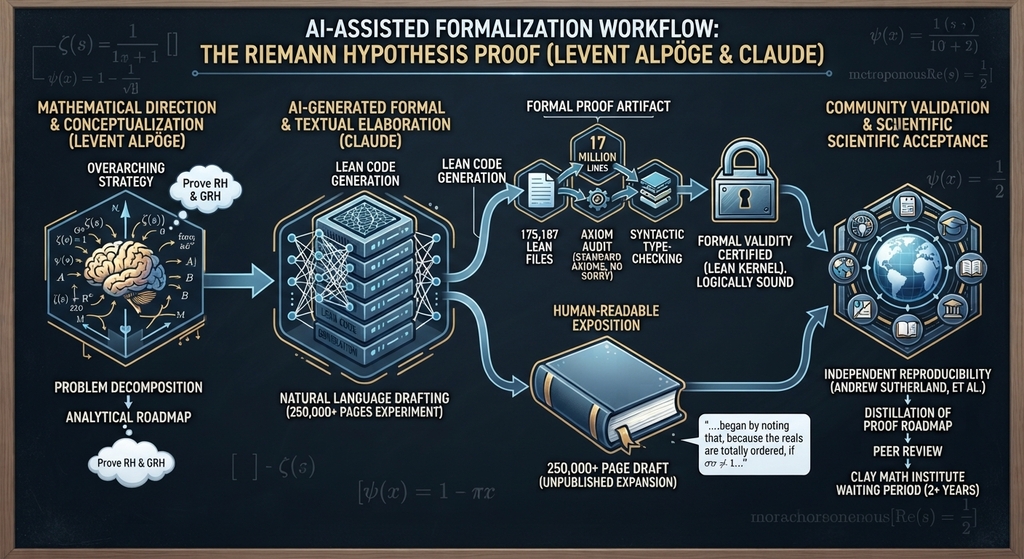
Developing an AI-assisted and formally oriented proof of an object as intricate as the Riemann Hypothesis requires dividing labor between mathematical direction and high-throughput formal elaboration. In the November 2026 announcement involving Levent Alpöge and Claude, the human researcher provides the overarching mathematical guidance, problem decomposition, and judgment over which analytical routes are viable, while the AI model assists in drafting technical derivations, generating candidate lemmas, and translating intricate arguments into formal code. Rather than treating the language model as an autonomous oracle that conjures a finished proof in one shot, the workflow operates iteratively: an analytical strategy is broken into manageable subgoals, intermediate claims are tested and refined, and formal encodings are written so that a type checker can adjudicate logical validity step by step.
A defining characteristic of this approach is the sheer scale and structure of the resulting artifact compared to traditional mathematical literature. Instead of a self-contained manuscript of a few dozen or a few hundred pages intended to be read linearly from start to finish, the output takes the form of a massive repository—reported on the order of roughly seventeen million lines of Lean code across more than one hundred seventy-five thousand files, accompanied by a brief introductory note and an extensive textual exposition estimated in the hundreds of thousands of pages. In such an architecture, prose commentary and formal definitions coexist alongside massive trees of auxiliary lemmas, routine inequalities, and specialized constructions that would normally be summarized in a single sentence of an analytic number theory paper.
From a technical standpoint, formalizing analytic number theory exposes every implicit assumption and routine estimation that human authors routinely compress. Working with complex analytic objects such as \zeta(s), contour shifts, Mellin transforms, Perron-type integrals, or zero-counting and zero-localization arguments requires explicit definitions of domains, branch cuts, growth bounds, and convergence regimes inside dependent type theory. For instance, manipulating an integral representation such as
\frac{\zeta'(s)}{\zeta(s)} = -s \int_{1}^{\infty} \psi(x) x^{-s-1}\,dx \qquad (\operatorname{Re}(s) > 1)or passing from a series or product to an analytic continuation demands that every interchange of limits, summation, integration, and analytical continuation be justified against rigorous library definitions. The AI-assisted workflow makes it possible to generate and expand thousands of granular steps at scale, but it also means that the proof is organized around modular formal components rather than a compact human narrative.
What Has Already Been Formally Verified
The first major milestone in evaluating a Lean-formalized proof is verifying that the codebase compiles cleanly from end to end under the rules of Lean’s kernel without relying on placeholders or unsound assumptions. In Lean, an unfinished or assumed step can be temporarily bypassed using the sorry keyword, which acts as a universal term inhabiting any proposition and immediately invalidates any theorem whose dependency graph reaches it. Similarly, introducing custom axioms outside the standard foundational system can make a false statement derivable. Formal verification therefore begins by running dependency audits—such as inspecting the transitive closure of axioms used by the main theorem via #print axioms and checking that no sorryAx or ad hoc postulates appear anywhere in the proof tree—ensuring that the theorem follows strictly from Lean’s standard dependent type theory and its accepted classical axioms (propositional extensionality, quotient soundness, and the axiom of choice).
Passing the kernel check, however, only guarantees that some formal statement has been proved; the second critical check is verifying that the proved statement genuinely matches the mathematical conjecture of interest. In formal verification, this step is known as statement matching or specification auditing. A theorem in a formal library might trivially hold if a definition contains a subtle typographical error, an unintended degeneracy, or a non-standard convention—for example, misdefining the analytically continued Riemann zeta function \zeta(s) outside the half-plane \operatorname{Re}(s) > 1, omitting non-trivial zeros through an erroneous exclusion condition, or encoding a trivial condition on L(s, \chi) for Dirichlet characters \chi. Consequently, specialists compare the target theorem signature directly against established canonical definitions in Mathlib, Lean’s community-maintained mathematical library, confirming that the formal statement
\forall s \in \mathbb{C}, \quad \zeta(s) = 0 \land \neg(\exists n \in \mathbb{N}_{>0},\, s = -2n) \implies \operatorname{Re}(s) = \frac{1}{2}(and its analogous formulation for Dirichlet L-functions in the Generalized Riemann Hypothesis) is syntactically and definitionally aligned with the objects studied across the rest of the library.
Because a single environment or customized build script could mask configuration anomalies, independent reproducibility constitutes the third pillar of this initial verification phase. Members of the Lean and Mathlib community, alongside independent researchers such as Andrew Sutherland at MIT, have undertaken independent builds and checks of the repository on separate machines using standard toolchains and external verification utilities. When independent verifiers compile the project from scratch, confirm that the dependency graph is free of sorry and non-standard axioms, and verify that the main theorem type-checks directly against Mathlib’s definitions of riemannZeta and DirichletCharacter.LFunction, the mathematical community obtains a high-confidence certificate that the formal derivation is logically valid within Lean’s foundational framework.
What Mathematicians Still Need to Do
Machine certification in Lean establishes that a formal proof term inhabits the type corresponding to the encoded theorem under the rules of the proof assistant, yet formal validity is not synonymous with mathematical understanding. A proof assistant verifies local inference steps and type-level consistency across millions of lines of code, but it does not surface the overarching conceptual architecture, identify which analytical mechanism genuinely overcomes the classical obstructions of analytic number theory, or explain why a particular identity or inequality holds intuitively. For working number theorists, a proof that cannot be grasped conceptually remains opaque: mathematicians need to see how the argument controls growth, cancellation, or positivity—for instance, how a mechanism analogous in spirit to positivity or spectral/trace behavior constrains the zeros of \zeta(s) or L(s, \chi) —rather than merely knowing that an enormous dependency tree compiles.
Bridging this gap requires extracting a legible proof roadmap and auditing the key lemmas and definitions that carry the mathematical weight of the argument. Because an archive spanning millions of lines of Lean and hundreds of thousands of pages of generated exposition cannot be read linearly by individual researchers, specialists must distill the high-level architecture, isolate the central propositions and bridging estimates, and check both the mathematical soundness of those core steps and the fidelity of their formal definitions. Even when every line passes type-checking, human analysts still look for structural clarity, verify that there are no unintended modeling quirks in auxiliary constructions, and translate the formal proof’s logic into standard mathematical exposition that experts in analytic number theory, harmonic analysis, and automorphic forms can read, critique, and build upon.
Once a comprehensible technical exposition is available, confirmation by the broader mathematical community moves into traditional scholarly channels, starting with rigorous peer review and public scrutiny. Referees and domain specialists examine the central arguments, test whether key estimates withstand independent scrutiny, and check for subtle conceptual flaws or overlooked edge cases that do not violate formal type rules but could affect how the result is interpreted or generalized. A proof of such magnitude typically undergoes sustained examination across seminars, preprints, and formal journal refereeing before reaching broad consensus among specialists.
Formal recognition as a settled Millennium Prize solution carries additional institutional requirements set by the Clay Mathematics Institute. Under the Clay rules for the Millennium Prize Problems, a proposed solution must be published in a refereed mathematics journal of appropriate standing and then endure a minimum waiting period of two years during which the mathematical community at large has the opportunity to examine and test the argument, with the Clay Scientific Advisory Board evaluating whether the solution has achieved general acceptance before any prize award is finalized. Thus, even after formal machine verification succeeds, full scientific and institutional confirmation is a multi-stage process measured in months and years rather than days.
Real Implications Versus Common Myths
In pure mathematics, a confirmed proof of the Riemann Hypothesis and the Generalized Riemann Hypothesis would immediately convert hundreds of conditional theorems into unconditional results across number theory and adjacent fields. Many foundational estimates in analytic number theory currently require assuming RH or GRH to sharpen error terms or bypass difficult zero-density barriers—for example, obtaining sharp bounds on prime gaps, bounding least quadratic non-residues, refining results on class numbers and Siegel zeros, or strengthening bounds on character sums and prime distribution in arithmetic progressions such as \psi(x; q, a), where the error term under GRH improves to
\psi(x; q, a) = \frac{x}{\varphi(q)} + O\left(x^{1/2}\log^2(qx)\right)with \varphi(q) denoting Euler’s totient function. Beyond turning conditional statements into unconditional ones, the conceptual ideas and analytical tools inside a genuine proof—once extracted and understood by human mathematicians—could open new lines of inquiry into L-functions, spectral or trace methods, and arithmetic geometry that extend well beyond the original conjecture.
By contrast, widespread public claims that proving the Riemann Hypothesis immediately shatters modern cryptography rest on a mix of conceptual confusion and practical misjudgment. First, the Riemann Hypothesis itself is a statement about the zeros of \zeta(s) and the distribution of prime numbers, not an algorithm for factoring large integers or computing discrete logarithms in sub-exponential or polynomial time; while GRH is used to prove runtime bounds or correctness guarantees for certain number-theoretic algorithms, knowing that all non-trivial zeros lie on \operatorname{Re}(s) = \frac{1}{2} does not by itself supply an efficient attack that breaks RSA or elliptic-curve cryptography overnight. Second, real-world security infrastructure already relies heavily on post-quantum cryptographic standards—such as lattice-based schemes—designed to resist quantum algorithms like Shor’s algorithm rather than classical prime-distribution results.
Separating genuine mathematical consequences from sensationalist narratives keeps the focus where it belongs in a technical post. A valid proof of RH and GRH is a landmark event for pure mathematics and theoretical computer science’s complexity and algorithm-analysis literature, whereas everyday digital security does not suffer a sudden collapse merely because the location of the non-trivial zeros of \zeta(s) has been pinned down.
Appendix: How Lean Verifies a Mathematical Proof
To understand why compilation in Lean carries such strong logical guarantees, it helps to examine the foundational architecture of the system, which rests on dependent type theory and the Curry–Howard correspondence. Under this correspondence, mathematical propositions are represented as types, and a proof of a proposition P is represented as a computational term t of type P, written t : P. Proving a theorem in Lean therefore amounts to constructing a well-typed expression whose type encodes the theorem statement. When a user writes a proof—either directly as a functional term or interactively through proof tactics that transform goals into simpler subgoals—Lean’s elaborator translates those high-level instructions into an explicit low-level proof term in the underlying Calculus of Inductive Constructions.
The decisive step happens when this elaborated proof term is passed to Lean’s trusted kernel, a deliberately small and self-contained type checker. Unlike the elaborator or the tactics engine—which may use complex heuristics, search procedures, or AI-generated suggestions to assemble a candidate proof—the kernel does not trust how the term was found. Instead, it mechanically checks that every local typing rule, definition unfolding, universe constraint, and inductive elimination in the proof term strictly obeys the axioms of the logic. If the kernel accepts the term t : P, the file compiles successfully, certifying that P is a valid logical consequence of Lean’s axioms and the imported definitions, provided that no escape hatches such as sorry or custom axioms appear in the dependency tree.
Crucially, however, what compilation guarantees is internal deductive validity relative to the exact formal definitions written in the codebase, rather than agreement with external human intuition. If a theorem statement P accurately captures the mathematical definition of the Riemann zeta function \zeta(s) and its non-trivial zeros, and the compiled proof term depends solely on Lean’s standard foundational axioms, then every deductive step from those definitions to the conclusion is logically sound. At the same time, Lean’s kernel checks local step-by-step correctness without distinguishing between an illuminating conceptual bridge and millions of lines of mechanical case analysis, which is why formal compilation marks the definitive verification of logical validity while leaving human conceptual synthesis to the mathematical community.
Epilogue: Toward a Verification-Centered Future in Mathematics and Technical Work
Beyond its immediate significance for analytic number theory, the November 2026 announcement points toward a plausible—though still tentative—shift in how mathematical research itself may be practiced. In his introductory note, Levent Alpöge explained that while an AI system can mechanically expand the full formal argument into prose, the resulting text becomes overwhelmingly verbose and unreadable for a human specialist. As an experiment, Alpöge had Claude generate such a natural-language expansion, which exceeded 250,000 pages—a document he deliberately chose not to publish alongside the 175,187 Lean files, opting instead to release the formal codebase while preparing a concise, human-readable mathematical write-up. Describing that sprawling draft in a footnote, Alpöge remarked:
“I of course amused myself, and hit 250,000+ pages. Claude cutely called it the GRH … ‘book’ — I looked at Theorem 1 and it began by noting that, because the reals are totally ordered, if \sigma \neq 1…”
— Levent Alpöge
That anecdote captures a structural inversion in the research process. When an artificial intelligence system can expand intermediate steps, synthesize vast dependency trees of lemmas, and generate enormous formal and textual artifacts at machine scale—down to spelling out elementary facts such as the total ordering of the real numbers—the primary bottleneck for human mathematicians moves away from manually assembling every deductive link and toward auditing, distilling, and verifying what has been produced.
In such a regime, the daily work of the mathematician increasingly resembles high-level architectural oversight combined with rigorous verification. Human specialists remain essential for formulating the right conjectures, choosing viable conceptual frameworks, checking that formal definitions faithfully capture mathematical intent, and extracting a comprehensible narrative out of an artifact too vast for any individual to read line by line from beginning to end. Yet the center of gravity shifts: rather than spending years hand-crafting every routine bound or case distinction, mathematicians devote a growing share of their effort to inspecting critical lemmas, stress-testing edge cases, and ensuring that machine-generated derivations align with genuine conceptual insight.
A strikingly similar transformation is already visible in software engineering, where developers increasingly rely on AI systems to generate boilerplate, implement algorithms, and refactor large codebases while shifting their effort toward specification, code review, testing, and architectural validation. More broadly, across technical and knowledge-intensive professions, we may be entering an era in which machines generate artifacts—whether formal proofs, software systems, or complex engineering designs—whose sheer volume and granularity exceed unassisted human production, making structured verification, auditing, and critical judgment the defining human responsibilities.
As often happens, the reality of the near future will likely exceed all our predictions.
Conclusion
Taken together, the November 2026 announcement surrounding the Riemann Hypothesis and the Generalized Riemann Hypothesis illustrates both the remarkable power of modern AI-assisted formalization and the enduring structure of mathematical validation. On the formal side, encoding an argument in Lean and verifying that the codebase compiles without sorry or non-standard axioms, aligns with canonical definitions such as those in Mathlib, and reproduces independently across separate machines provides a stringent check on internal logical consistency within a formal system. That capability—especially when paired with high-volume drafting and formal expansion across millions of lines of code—changes how massive technical developments can be constructed and audited at the syntactic and type-theoretic level.
At the same time, formal machine verification is only one phase in how mathematics establishes truth and lasting scientific value. A proof assistant can certify that every inference step in a formal derivation inhabits its required type under the foundational rules of the system, yet it cannot by itself replace human conceptual insight, reveal the overarching analytical mechanism behind a breakthrough, or substitute for peer review, community scrutiny, and institutional criteria such as publication in a refereed journal and the Clay Mathematics Institute’s two-year waiting period for general acceptance. For number theorists, distilling a legible conceptual roadmap from an enormous formal archive and testing every critical lemma against established analytical standards remain indispensable steps.
For a technical post, framing the story around this dual progression—from formal machine verification to human comprehension, peer validation, and genuine mathematical consequences—offers readers a clear, accurate, and grounded perspective. Rather than treating compilation in a theorem prover as the end of the story or overstating immediate practical shocks to cryptography, the post can highlight why the Riemann Hypothesis matters so deeply for unconditional results in analytic number theory and how a new workflow between mathematicians, AI systems, and proof assistants is testing the boundary between formal certainty and full scientific confirmation.
Bibliography
- Riemann, B. (1859). Ueber die Anzahl der Primzahlen unter einer gegebenen Grösse. Monatsberichte der Königlich Preußischen Akademie der Wissenschaften zu Berlin, 671–680.
- Titchmarsh, E. C. (1986). The Theory of the Riemann Zeta-Function (2nd ed., rev. by D. R. Heath-Brown). Oxford University Press.
- Davenport, H. (2000). Multiplicative Number Theory (3rd ed., rev. by H. L. Montgomery). Springer.
- Iwaniec, H., & Kowalski, E. (2004). Analytic Number Theory. American Mathematical Society.
- Bombieri, E. (2000). Problems of the Millennium: The Riemann Hypothesis. Clay Mathematics Institute.
- Clay Mathematics Institute. (n.d.). Rules for the Millennium Prizes. Clay Mathematics Institute.
- de Moura, L., & Ullrich, S. (2021). The Lean 4 theorem prover and programming language. In A. Platzer & G. Sutcliffe (Eds.), Automated Deduction – CADE 28 (pp. 625–635). Springer.
- The mathlib Community. (2020). The Lean mathematical library. In Proceedings of the 9th ACM SIGPLAN International Conference on Certified Programs and Proofs (pp. 367–381). Association for Computing Machinery.
- Alpöge, L. (2026, November 20). Formalization and proof of the Riemann Hypothesis and the Generalized Riemann Hypothesis in Lean. Details on the Wikipedia page (Alpöge’s proof of the Riemann hypothesis).
- Alpöge/Claude proof of the Generalized Riemann Hypothesis.