
Architecture of Governance: Reimagining Human Agency, Epistemology, and Structural Power in the Era of Artificial Intelligence
 Francisco Yepes Barrera 8 min read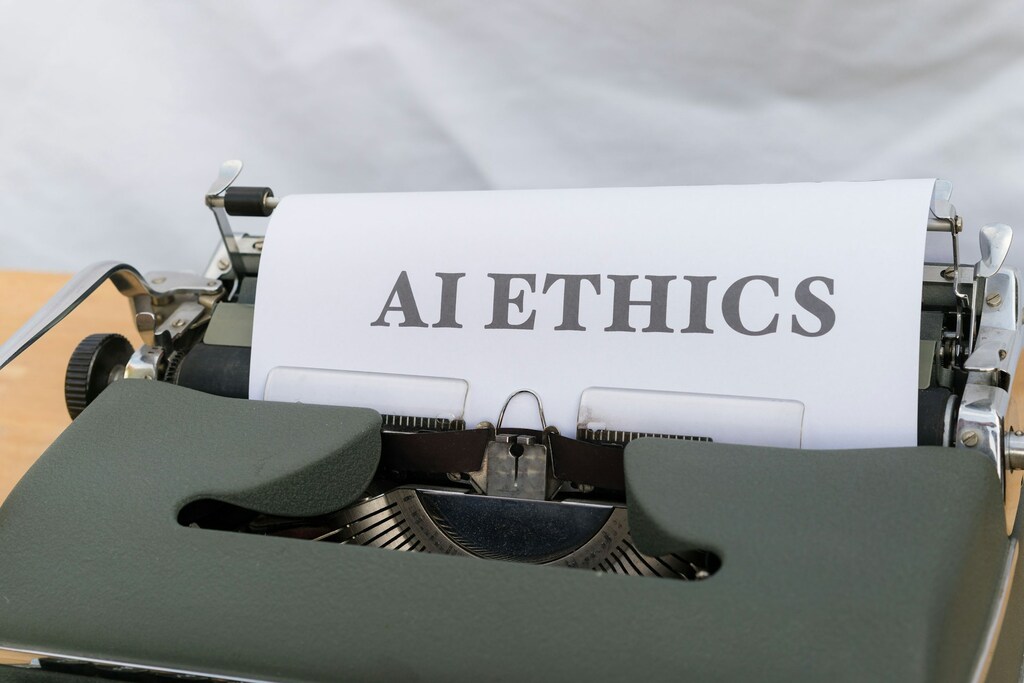
Markus Winkler - https://unsplash.com/photos/a-close-up-of-a-typewriter-with-a-paper-on-it-MBvXOkr7BrE
Table of Contents
Understanding AI Ethics
The popular and corporate discourse surrounding artificial intelligence ethics often suffers from a reductionist paradigm, treating complex normative and sociopolitical questions as mere technical engineering bugs awaiting algorithmic patches or parameter adjustments.
To understand AI ethics in its true, substantive sense, one must depart from the convenient myth that algorithms are neutral mathematical instruments applied to raw, objective reality.
Instead, artificial intelligence represents a deeply intertwined socio-technical ecosystem where human values, historical power imbalances, economic incentives, institutional biases, and mathematical optimization techniques interweave.
At its foundational level, AI ethics is not simply a set of compliance checklists for technology corporations or a list of prohibitive boundaries designed to avoid public relations failures. It is an inquiry into the ongoing redistribution of human agency, epistemological authority, and institutional power.
When a computational model translates unstructured human experience, micro-behaviors, or social dynamics into quantifiable matrices to predict behavioral outcomes, it is engaged in an inherently philosophical act.
It defines what counts as actionable knowledge, shapes what is perceived by institutions as normal or anomalous, and determines who receives opportunities, resources, or systemic burdens.
The primary theoretical challenge in conceptualizing AI ethics lies in the fundamental tension between human moral intent and machine execution.
Traditional normative ethics, ranging from Kantian duty-based frameworks to utilitarian calculations of collective welfare, were constructed upon the premise of human moral agents capable of reflection, empathy, contextual understanding, and moral responsibility.
Modern statistical learning systems operate entirely without consciousness, moral awareness, or intrinsic comprehension of human dignity; they function purely through the optimization of mathematical objective functions across complex, historical dataset distributions.
Consequently, AI ethics must bridge the vast conceptual gap between abstract human normative principles and concrete computational design choices. It requires translating qualitative notions such as fairness, justice, human rights, and accountability into technical architectures, data collection protocols, loss functions, and organizational governance frameworks. Without this deep structural integration, ethical commitments remain superficial slogans that mask automated harms under the guise of technological inevitability.
Key Ethical Issues in AI
Among the foundational dilemmas confronting contemporary technological deployment, algorithmic bias and systemic discrimination remain among the most urgent and pervasive.
Machine learning models do not invent societal prejudices out of thin air; rather, they formalize, scale, and accelerate preexisting inequalities. When trained on decades of historical data reflecting institutional marginalization in hiring practices, housing markets, criminal justice, or credit scoring, optimization algorithms internalize these structural disparities as immutable mathematical truths.
A striking historical illustration of this dynamic unfolded in the domain of criminal justice with risk assessment tools like COMPAS, which were deployed to predict recidivism rates among arrestees. Studies revealed that the underlying statistical algorithms exhibited systemic disparities, producing significantly higher false-positive rates for Black defendants compared to white defendants—misclassifying Black individuals as high-risk at almost double the rate despite similar offending profiles.
Similarly, when major technology corporations trained automated recruitment software on historical hiring data spanning decades, the models automatically learned to penalize resume submissions containing words associated with women, reflecting the historical gender imbalances of the tech industry. The unique danger of algorithmic discrimination lies in its deceptive presentation: wrapped in an aura of mathematical objectivity and technical neutrality, systemic discrimination becomes significantly harder to audit, contest, or dismantle than explicit human prejudice.
Compounding this problem is the systemic opacity inherent to complex computational models, universally referred to as the black box phenomenon. Contemporary deep neural networks, particularly large language models and multi-layered neural architectures containing hundreds of billions of parameters, map non-linear connections across high-dimensional data spaces that completely elude direct human interpretability. Even the computer scientists who design and train these systems cannot trace the precise reasoning pathways that lead to a specific output.
This lack of explainability presents severe ethical dilemmas in high-stakes public and private domains. Consider the deployment of automated welfare allocation systems, such as the infamous SyRI system in the Netherlands or the Robodebt scandal in Australia, where automated algorithms wrongfully flagged thousands of vulnerable citizens for fraudulent welfare claims, issuing automated debt notices without human oversight or clear explanatory mechanisms.
When algorithmic systems determine medical diagnoses, judicial sentencing, or access to public housing without interpretable decision pathways, the fundamental democratic right to due process and administrative appeal is severely eroded, leaving affected individuals powerless against automated bureaucratic determinations.
Furthermore, the expansion of machine intelligence fundamentally transforms personal privacy, shifting the boundary from passive data collection to pervasive, active surveillance.
Modern AI tools practice predictive surveillance, aggregating micro-behaviors, biometric signatures, facial expressions, location histories, and digital footprints into hyper-detailed psychological profiles.
The deployment of facial recognition technology by state authorities in public spaces provides a salient example of how fundamental civil liberties can be chilled, converting public squares into spaces of perpetual identification and tracking.
This dynamic shifts the core privacy challenge from preserving simple data confidentiality to preserving intellectual, psychological, and behavioral autonomy. When machine learning models can anticipate human choices, emotional vulnerabilities, and cognitive biases at scale, human free will becomes vulnerable to automated behavioral modification, targeted political manipulation, and commercial exploitation.
The problem of accountability remains structurally unresolved in modern software deployment.
When an autonomous vehicle collides with a pedestrian, when an agentic language model generates catastrophic medical misinformation, or when an automated financial trading network triggers a flash crash, responsibility becomes dangerously diffused. The chain of accountability stretches across data annotators, software engineers, third-party model fine-tuners, corporate executives, deployment personnel, and end-users. This structural diffusion risks creating a corporate scenario where everyone is involved in the technical deployment process, yet no singular entity assumes legal or moral liability for harmful machine outputs.
Implications of AI Ethics on Society
The societal consequences of deploying non-aligned artificial intelligence ripple far beyond computer science laboratories, fundamentally restructuring economic systems, political institutions, and cognitive self-determination. Economically, the rapid advancement and deployment of generative and analytical automated systems threaten to exacerbate wealth concentration while inducing structural labor instability. Unlike previous industrial transformations that primarily automated routine physical labor, artificial intelligence targets complex cognitive, creative, and administrative tasks.
While productivity increases exponentially across industries, the financial returns accrue disproportionately to a small group of technological infrastructure monopolies, cloud compute providers, and capital holders. Meanwhile, vast segments of the cognitive workforce face skill obsolescence, income devaluation, and precarious employment conditions, threatening to widen the economic chasm between capital owners and labor force participants.
Politically, the proliferation of synthetic media and automated content generation severely threatens the foundational integrity of democratic discourse.
Hyper-realistic deepfakes, automated social media bot networks, and personalized micro-targeted propaganda feeds degrade our shared informational ecosystem. Democratic self-governance relies intrinsically on a baseline public consensus regarding factual realities.
When hyper-realistic audio-visual media can be endlessly generated, forged, and personalized at zero marginal cost to fabricate events, alter political speeches, or impersonate figures, public trust in information mediums collapses entirely.
This environment induces a state of epistemic cynicism where citizens no longer know what to believe, allowing political actors to dismiss genuine evidence as synthetic fabrications—a phenomenon known in legal and political discourse as the liar’s dividend.
At the individual psychological level, subtle yet profound transformations occur through continuous human interaction with hyper-optimized engagement algorithms and artificial conversational companions.
As human relationships and daily communication are progressively mediated by synthetic interlocutors designed to maximize attention metrics, human cognitive habits adapt to the medium. Cognitive offloading shifts basic critical thinking, memory retention, synthesis, and emotional processing onto automated systems. Over extended periods, this systemic reliance risks causing cognitive atrophy, diminishing our collective capacity for nuance, deep reading, contextual reflection, and sustained interpersonal empathy.
Human beings risk conditioning themselves to expect the friction-free, perfectly tailored responses of synthetic models, diminishing their patience for the inherent complexity and friction of authentic human relationships.
Future Directions for AI and Ethics
To navigate the future of artificial intelligence responsibly, global society must decisively move past voluntary, non-binding corporate ethics pledges and superficial principles toward enforceable regulatory frameworks, institutional accountability, and systemic design shifts.
The future of AI governance demands a shift from reactive risk management—responding only after societal harm has materialized—to proactive, values-by-design engineering frameworks.
Regulatory bodies across international jurisdictions are increasingly adopting structured, risk-tiered operational frameworks, as exemplified by comprehensive legislative efforts like the European Union AI Act. The future of effective governance requires binding legal standards that mandate independent third-party algorithmic auditing before public deployment, comprehensive algorithmic impact assessments, continuous post-market surveillance, and verifiable lineage tracing for training dataset distributions. Furthermore, legal systems must establish clear strict liability regimes to ensure that technology creators and deployers remain legally responsible for systemic harms caused by their deployed models.
Technologically, research priorities must reorient toward verifiable alignment techniques, mechanistic interpretability, and privacy-preserving computational methodologies.
Innovations such as zero-knowledge proofs, federated learning, and differential privacy offer promising technical pathways, allowing statistical models to derive valuable research insights from sensitive human data without directly exposing, centralizing, or compromising individual privacy rights.
Ultimately, the future of artificial intelligence and ethics rests on democratizing technology development itself. Instead of allowing a concentrated cluster of corporate technology monopolies to unilaterally define the trajectory of human progress and societal values, technical development must systematically incorporate multidisciplinary perspectives. Ethicists, sociologists, legal scholars, labor organization representatives, and historically impacted communities must have direct agency in determining which AI systems are built, how they are constrained, and where their deployment should be prohibited altogether. Artificial intelligence must function not as an autonomous substitute for human judgment and democratic authority, but as an empowering tool explicitly designed to enhance human agency, advance social equity, and safeguard fundamental human rights.
Bibliography
- Bostrom, N. (2014). Superintelligence: Paths, Dangers, Strategies. Oxford University Press.
- Benjamin, R. (2019). Race After Technology: Abolitionist Tools for the New Jim Code. Polity Press.
- Crawford, K. (2021). Atlas of AI: Power, Politics, and the Planetary Costs of Artificial Intelligence. Yale University Press.
- Eubanks, V. (2018). Automating Inequality: How High-Tech Tools Profile, Police, and Punish the Poor. St. Martin’s Press.
- Floridi, L. (2019). The Logic of Information: A Theory of Philosophy as Conceptual Design. Oxford University Press.
- McDermott, Y. (2020). Synthetic Media, Deepfakes, and the Law: Epistemic Disruption in Democratic Societies. Cambridge University Press.
- Noble, S. U. (2018). Algorithms of Oppression: How Search Engines Reinforce Racism. NYU Press.
- O’Neil, C. (2016). Weapons of Math Destruction: How Big Data Increases Inequality and Threatens Democracy. Crown Publishing Group.
- Pasquale, F. (2015). The Black Box Society: The Secret Algorithms That Control Money and Information. Harvard University Press.
- Russell, S. (2019). Human Compatible: Artificial Intelligence and the Problem of Control. Viking.
- Vallor, S. (2016). Technology and the Virtues: A Philosophical Guide to a Future Worth Wanting. Oxford University Press.
- Zuboff, S. (2019). The Age of Surveillance Capitalism: The Fight for a Human Future at the New Frontier of Power. PublicAffairs.