 Francisco Yepes Barrera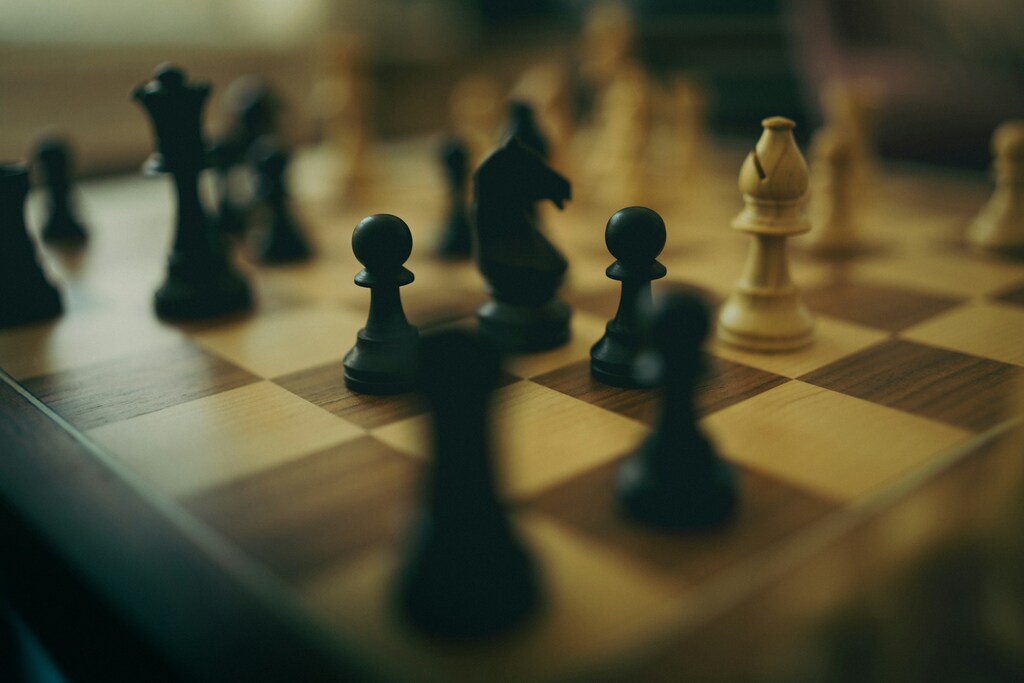
Lilian V - https://unsplash.com/es/fotos/las-piezas-de-ajedrez-se-colocan-en-un-tablero-de-ajedrez-rCe5KYyrPQU
This article was published in Spanish in the Cuaderno de Cultura Cientifica (CCC) under the title “¿Por qué la IA es tan buena al ajedrez?“, under a Creative Commons Attribution-NonCommercial-NoDerivatives 4.0 International License. Except for the English translation, no changes were made to the original article. Published with permission of CCC.
The author, César Tomé López is a scientific communicator and editor of Mapping Ignorance.
Deep Blue defeated Kasparov in 1997. Two decades later, AlphaZero taught itself to play at a superhuman level. Today, engines like Stockfish and Leela Chess Zero outperform any human. We already know this, yet it leaves an open question with a not-so-obvious answer: What exactly do these machines do differently when playing chess?
A recent article offers an answer. Its authors approach chess like physicists studying complex systems. Their conclusion: the best programs sustain positions with densely interconnected pieces for much longer, whereas grandmasters simplify the game sooner. It is not that humans cannot play complex positions—in fact, at times they may reach levels of complexity even higher than a machine’s—but the difference lies in endurance, not peak performance. AI is trained to run marathons at a world-record pace; an elite player is a skilled 1,500-meter runner who ventures into longer races, while a chess match is a 5,000- or 10,000-meter race.
Table of Contents
A Board Turned into a Network
Let’s imagine a position: a rook threatens a piece, that piece is protected by a knight, the knight could fall to a bishop, and that bishop depends on another piece. Even empty squares matter if several pieces compete for them. The authors turn this web of relationships into a network (pieces and boxes as nodes, threats, defenses, and controls as links), a common type of representation in network science, a discipline that also studies epidemics or electrical networks.
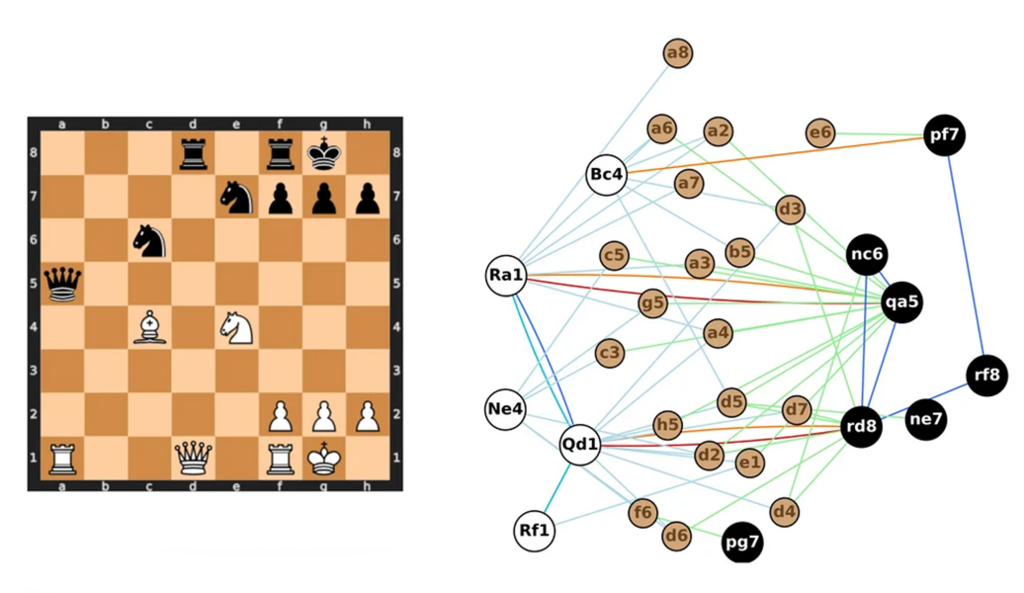
To summarize that entire structure in a single number, they use the spectral radius—a classic tool in network algebra that indicates the extent to which a network allows for chains of paths between its elements. The higher this value, the more “open” and potentially explosive the position is. They call this quantity “strategic tension”: this refers not to anxiety at the board but to an objective measure of how interconnected (and, therefore, unstable) the pieces are.
A Matter of Sustained Tension
The authors analyzed approximately 1,200 games played by grandmasters and an equal number between top-tier engines (Stockfish and Leela Chess Zero in TCEC tournaments), as well as games where Stockfish played against itself at varying calculation depths and human games played at different time controls.
In every case, the game follows a similar sequence: development, rising tension, a peak, and simplification. The difference lies in when that peak occurs and what follows. For humans, the peak arrives earlier and drops off quickly; for machines, it arrives later and dissipates much more slowly. Consequently, although the instantaneous peak of tension may be higher in human games, the cumulative tension over the course of the entire game is clearly greater in machine games—to use an athletics analogy, one runner has a higher top speed, while the other maintains a very high pace for a much longer duration.
This capacity to sustain tension increases with computing power: greater search depth in Stockfish results in higher cumulative tension, whereas there is a clear plateau when the depth is low. A similar pattern appears in humans regarding skill level, with notable jumps occurring around the 1,600 and 2,100 Elo rating marks. Time also plays a role: in classical games, which allow more time for thought, humans sustain complex positions longer than they do in rapid games.
We Need to Simplify
Simplifying reduces the number of things that need to be monitored. For a human—incapable of examining every possible variation—this reduction is valuable; ever since Adriaan de Groot’s classic studies on chess thinking, it has been known that knowing how to discard lines is just as important as calculating accurately. A machine, by contrast, can explore vast numbers of variations without fatigue; thus, a position that is cognitively overwhelming for us might be precisely the one a chess engine prefers to keep open, for as long as the possibilities remain open, so do the opportunities.
It Is Not Advisable to Extrapolate
The authors themselves note that chess involves perfect information and fixed rules—vastly different from real-world conflicts, which are characterized by incomplete information and unexpected events. These results prove nothing regarding international relations, for instance, though they do point to a general mechanism: we simplify because we can only handle a limited amount of complexity in our minds. Nor does this imply that simplifying is a mistake; any player with some experience knows that, when holding a material advantage, exchanging pieces is usually the right move. Furthermore, the time controls for the human games in the sample are less well-documented than those of the AI tournaments, warranting a degree of caution.
What the study does demonstrate is that both humans and machines arrive at very sound decisions using different strategies to handle complexity; however, we pay a price for our cognitive limitations, whereas the machine can afford to leave the conflict unresolved for longer.
Bibliography
Adamo Cerioli, Edward D. Lee, and Vito D. P. Servedio (2026) Artificial intelligence sustains higher strategic tension than humans in chess APS Open Sci. doi: 10.1103/63cv-52fj